
Lancaster Court Records After Jail Arrest
After a Lancaster County arrest, the jail and the courts track different parts of the same event. The Lancaster County Local Correctional Facility may confirm local custody and keep booking records. Those jail records can show that a person was booked, released, held for bond, or moved. The court record begins when a criminal case is entered in the Virginia court system. That case may be based on an arrest warrant, summons, complaint, indictment, or another charging document.
The Commonwealth's Attorney for Lancaster County is Anthony G. Spencer. The prosecutor's office reviews criminal cases for the Commonwealth and can proceed with a filed charge, amend it, reduce it, ask for indictment, or move to dismiss it. A booking charge and a prosecutor-filed charge can look similar, but they are not the same record. Custody and booking details belong with Lancaster County jail inmate records, while booking photos are handled through the Lancaster County jail mugshots topic. Court records after a jail arrest focus on the filed case, hearing dates, bond orders, status, and disposition.
The basic path is: arrest, booking, first appearance or bond review, prosecutor charging decision, then court case record. If a person is still in local custody, the jail may be the fastest custody check. If the question is what charge is actually pending, the court case system or the clerk is the better source.
Search Lancaster Court Records After Jail Arrest
Virginia provides more than one official court search path. The Virginia court case status page describes statewide adult criminal search, circuit court case information, and general district court case information. Lancaster criminal and traffic matters may appear in different systems based on the case type and court level. Misdemeanors, traffic cases, and many preliminary felony matters often begin in General District Court. Felony indictments and felony trials are handled in Circuit Court.
- Start with the correct court type. Use General District Court for many new criminal and traffic cases, and Circuit Court for felony indictments, trials, and older circuit files.
- Search by defendant name when a case number is not known. Add locality or court location so the search stays tied to Lancaster County.
- Use a case number from a summons, warrant, or clerk notice when available. It is the cleanest way to avoid same-name results.
- Open the case detail and read each charge line. Check offense text, code section, hearing date, bond entry, status, and disposition if one has been entered.
- Contact the correct clerk if the case is missing, old, sealed, not yet entered, or not available online.
The Virginia OCIS statewide search covers adult criminal and traffic information and select circuit records, but payments cannot be made through the statewide search. The General District Court Online Case Information System is the official general district search and payment path. The Lancaster Circuit Court Clerk also links to circuit case information through the county clerk page.
The screenshot comes from the Virginia case status page, the state hub that points users to the separate court systems used for adult criminal case lookup.
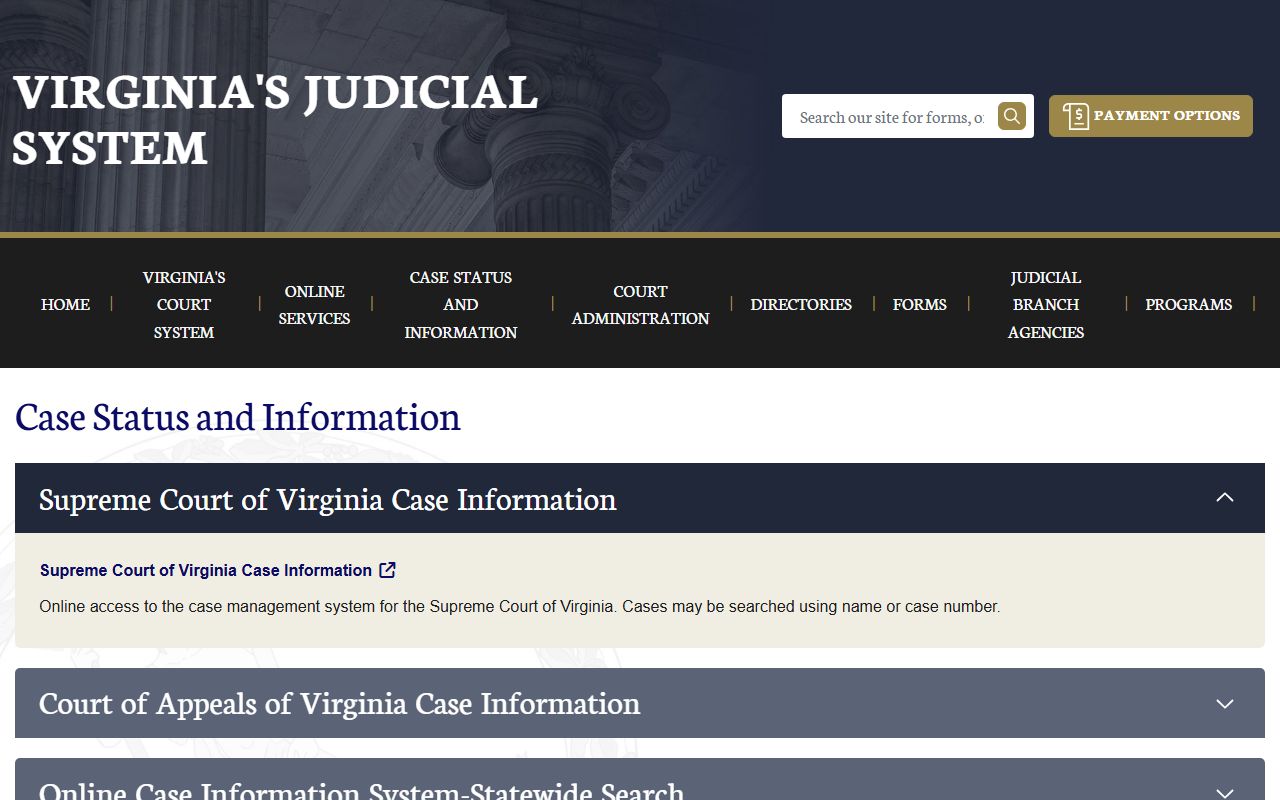
Use the state page as a routing point, then narrow the search to the court that holds the Lancaster County arrest case.
Lancaster Court Records Search Fields
Official Virginia court descriptions identify the main search fields for case lookup. A Lancaster County court records after arrest search may need more than one attempt because a person can have a common name, the case may be newly filed, or the case may sit in a different court level than expected. Juvenile and Domestic Relations District Court is different. Virginia's court self-help page says no online case information is available for juvenile cases, which protects confidentiality.
| Field Label | Type | Required | Options or Format Notes |
|---|---|---|---|
| Locality or Court | Dropdown or select | Yes | Select Lancaster or the specific court location for circuit or general district search. |
| Name | Text | One search method | Useful when the case number is unknown. Middle names or initials can reduce false matches. |
| Case Number | Text | One search method | Use the number from a summons, warrant, court paper, or clerk notice if available. |
| Hearing Date | Date | One search method | Helpful when a defendant name is common or when the case number is not known. |
| Court Type or System | Portal choice | Yes | Choose statewide OCIS, Circuit Court Case Information, or General District Court Case Information. |
Lancaster court clerk contacts are important when an online search is not enough. Circuit Court Clerk Diane H. Mumford is at the Lancaster Judicial Center, 8265 Mary Ball Road, P.O. Box 99, Lancaster, VA 22503, phone 804-462-5611, with hours of 8:30 a.m. to 4:30 p.m. General District Court Clerk Victoria Keyser can be reached at 804-462-0012. Juvenile and Domestic Relations District Court Clerk Kathleen Taft can be reached at 804-462-7250.
Lancaster Arrest Charging Documents
A charging document is the paper or court filing that tells the court what offense is alleged. It is not the same as a jail intake note. After a Lancaster County arrest, the first court record may start from an officer's charge, a magistrate-issued warrant, a complaint, or a prosecutor's filing. A felony can also move toward indictment, which is a grand jury charging act used in Circuit Court.
| Document | Who Uses It | Common Role After Arrest |
|---|---|---|
| Complaint | Officer, complainant, magistrate, or prosecutor process | Starts or supports a charge based on alleged facts, often near the arrest or warrant stage. |
| Information | Prosecutor | States the charge the Commonwealth chooses to pursue when that procedure applies. |
| Indictment | Grand jury | Moves a felony into Circuit Court for prosecution after grand jury action. |
These documents can change how court records after a jail arrest look. A person might be booked on one offense, face a reduced or amended charge later, or see a felony certified or indicted in Circuit Court. That is why the court case record should be checked after the booking stage rather than treating the arrest charge as the final charge.
Lancaster Charge Status Records
Charge status is the current condition of a filed case or count. It can change at hearings, after prosecutor review, or after a plea, trial, dismissal, or nolle prosequi. Nolle prosequi means the prosecutor will not proceed with that charge at that time. It is often shortened to "nolle pros" in court settings. A status label should be read with the hearing history and disposition, not by itself.
| Status | What It Usually Means | What to Check Next |
|---|---|---|
| Pending | The charge has not reached final disposition. | Look for the next hearing date, bond terms, and court level. |
| Amended or Reduced | The filed charge changed from an earlier wording, level, or code. | Compare the original arrest charge with the current court charge. |
| Dismissed | The court ended that charge without a conviction on that count. | Confirm whether other counts remain open. |
| Nolle Prosequi | The Commonwealth chose not to prosecute that charge at that time. | Ask the clerk or counsel how the entry affects the full case. |
| Convicted | The case ended in a guilty plea, verdict, or other conviction entry. | Review sentencing, costs, appeal status, and any active custody order. |
Online records can lag behind a live hearing. If release, bond, or a deadline depends on the status, call the clerk or the jail rather than relying only on a screen view.
Court Bond After Lancaster Arrest
Bond may be set by a magistrate after arrest or reviewed by a judge. Lancaster County official sources did not publish a local bond payment page, accepted payment methods, or bond desk hours. That gap should not be filled with guesswork. Confirm custody with the sheriff or jail at 804-462-5111, then check the court case or call the proper clerk for hearing and bond terms. If a bond appears available, ask where it must be posted and what payment form is accepted.
Virginia bond terms can include recognizance release, unsecured bond, secured bond, cash bond, surety bond, property bond, or no-bond hold. A surety bond uses a licensed bail bondsman. A recognizance release, often called PR or own recognizance, lets the person leave custody based on a promise to appear and any court conditions. A no-bond hold means release is not available unless the order changes.
A local bond does not always mean immediate release. Another jurisdiction, probation or parole, a federal agency, ICE, or VADOC may place a detainer or hold. A detainer is a request or notice from another authority that can keep a person in custody even when the Lancaster charge has a bond. Release also takes time while jail staff verify paperwork and active holds.
Lancaster Warrants and Court Records
No searchable Lancaster County active-warrant database was found in the official sources reviewed. The sheriff blotter page has a wanted-persons section and states that users should not try to detain or arrest a wanted person. The same page says people with information should call law enforcement. Use the official sheriff number, 804-462-5111, because the blotter text appeared to omit one digit in the phone number at the time of research.
Warrants can affect both jail custody and court records after a jail arrest. An arrest warrant authorizes an arrest for an alleged offense. A bench warrant is issued by a judge, often after a failure to appear or a violation of a court order. A search warrant allows a search of a place, person, or property and is not the same as an arrest-warrant list. A fugitive or other-agency warrant can create a hold in Lancaster County even if the local court charge has a bond.
Check the Lancaster sheriff blotter page for any current wanted-person update, then use court searches or clerk contacts for bench-warrant case history. VCIN and NCIC are law-enforcement systems, not public search databases. Do not walk into an office to clear a warrant without legal advice if arrest is possible.
Charges and Court Records
A charge is an accusation that has been entered into the criminal process. A conviction is a final result based on a guilty plea, verdict, or other conviction entry. Court records after a Lancaster County arrest may show charges that were pending, amended, dismissed, or not prosecuted. That record should not be described as a conviction unless the disposition actually says so.
Charge: An allegation before final judgment. It may be changed, dropped, or resolved without a conviction.
Conviction: A final court outcome based on a guilty plea, finding, or verdict. Sentencing and costs may follow.
Virginia expungement law is a separate topic from ordinary online case lookup. Code of Virginia section 19.2-392.2 governs qualifying expungement of police and court records after certain dismissals, acquittals, identity errors, absolute pardons, and other listed circumstances. Expungement is not automatic just because a case ended well for the accused.
Sealed: Public access is restricted, but certain courts or agencies may still have lawful access under defined rules.
Expunged: The record is treated under Virginia's expungement process for eligible police and court records.
Law-enforcement and criminal records also fall under Virginia FOIA and Code of Virginia section 2.2-3706. That law includes release rules and exemptions for criminal records, including limits tied to adult arrestee photographs when release would jeopardize a felony investigation.
Restricted Lancaster Court Records After Arrest
Not every arrest-linked case record is public online. Juvenile cases are the clearest example. Virginia's self-help materials state that no online case information is available for Juvenile and Domestic Relations District Court cases because of confidentiality. For Lancaster County juvenile matters, contact JDR Clerk Kathleen Taft at 804-462-7250 rather than looking for a public web docket.
Some adult records may also be limited because of sealing, expungement, an active investigation, court order, or the age and storage location of the file. The Lancaster Circuit Court Clerk keeps court files and historic records, and older or non-online records may require in-person, mail, or phone contact. The clerk page is the right starting point when a circuit court file does not appear in the online index.
The Lancaster Circuit Court Clerk page lists court-record duties, address, hours, and a circuit case information link.
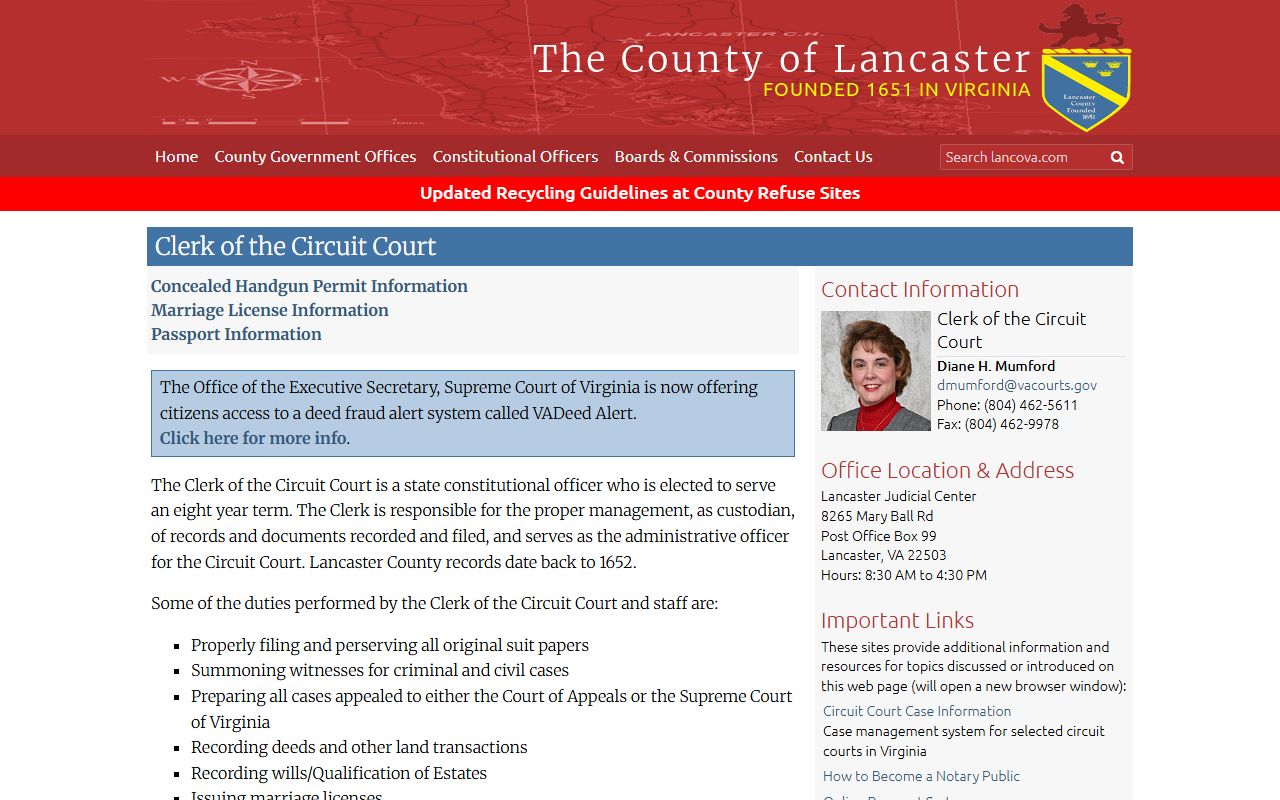
For a missing online case, use the clerk details from the county page before assuming that no court record exists.
Lancaster Prosecutor Contact
The Commonwealth's Attorney is the local prosecutor, not a District Attorney. Anthony G. Spencer's office is listed with a mailing address of P.O. Box 204, Lancaster, VA 22503-0204, and a delivery address at 8265 Mary Ball Road, Lancaster County Judicial Center, Lancaster, VA 22503. The office phone is 804-462-7240, and the listed hours are 8:30 a.m. to 5:00 p.m. Monday through Friday and by appointment.
Prosecutor staff do not replace the clerk for case-file access, and they do not confirm jail release for every caller. Their role in court records after a jail arrest is tied to prosecution decisions. Clerk contacts verify case entries, hearing dates, and file access. The sheriff confirms local custody and jail records. Keeping those roles separate reduces bad search results and wrong-office calls.
The Lancaster Commonwealth's Attorney contact page also lists court clerks, the sheriff, local police, Virginia State Police, and victim-witness contact information.
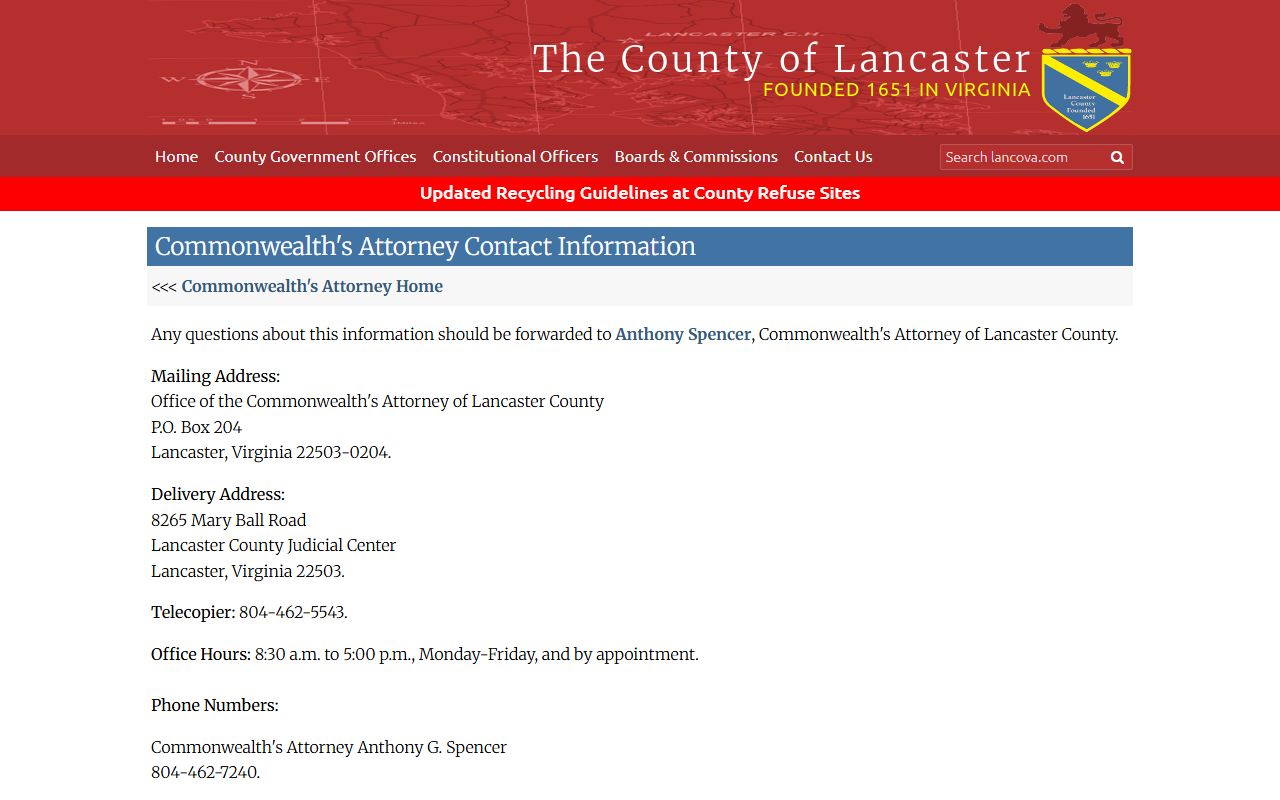
Use that official contact page when the question concerns the prosecutor's role in filed or amended charges.